
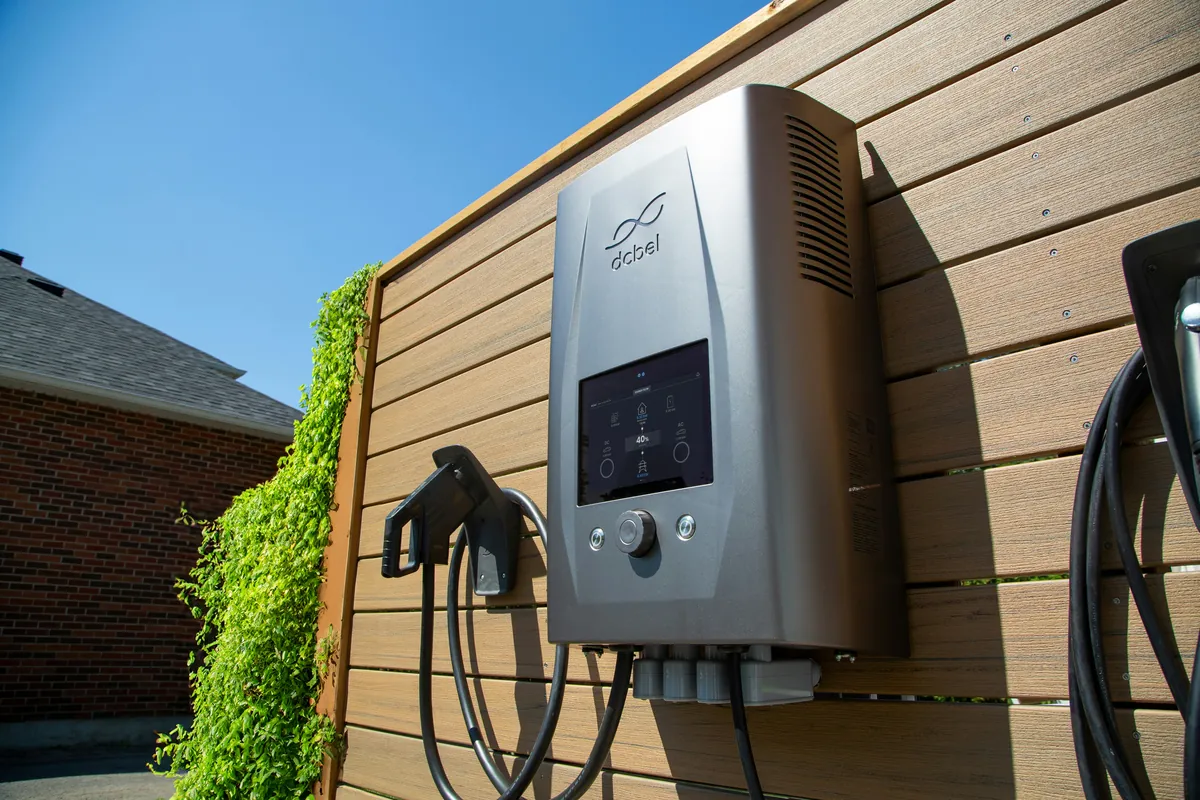
The pitch for home charging is simple, and mostly true: plug in at night, wake up full, and pay a fraction of what the same miles cost at a gas pump or a public fast charger. For most drivers in this metro it works out exactly like that.
But “a fraction” depends on things nobody mentions at the dealership: when you charge, what you charge from, and what the charger leaves behind in the panel. None of them is large on its own. Together they can cost hundreds a year more than they should — or a few thousand, once.
Here are the five we see most, and what each one takes to avoid.
Cost 1: Charging at the most expensive hour of the day
Most people get home between five and seven, plug in, and walk inside. The car starts charging immediately, because that is what it does by default.
On a flat-rate plan, that costs nothing extra. On a time-of-use plan — which utilities in the metro, PGE among them, offer — it is the worst moment you could have picked. The evening peak is the most expensive block of the day and the overnight block is the cheapest, often by a multiple.
The arithmetic is not subtle. A typical EV goes three to four miles on a kilowatt-hour. At the national average of about 37 miles a day, that is roughly 300 to 400 kWh a month at the wall. Move all of it from the peak window to the overnight one and the charging part of the bill can fall by half or more, for exactly the same miles.
The fix is free:
- Set a charging schedule in the car or in the charger’s app, so it waits for the off-peak window to start.
- Check which plan you are actually on. A time-of-use plan only pays off if the big loads move. Without a schedule, it can cost more than the flat rate.
- Ask about EV programs. Some utilities pay a credit, or offer a separate rate, for chargers that let them manage when charging happens.
Before you switch plans: look at a year of your usage, not a month. Time-of-use rewards households that can move their big loads — the car, the dryer, the water heater — and penalises the ones that cannot.
Cost 2: The energy that never reaches the battery
The meter on the side of the house counts every kilowatt-hour that leaves the panel. The car counts only what lands in the battery. The gap between the two is charging loss, and you pay for all of it.
Some loss is unavoidable: the car’s onboard charger converts AC to DC, the battery warms as it fills, and the car’s own electronics stay awake the whole time. How big the gap gets depends mostly on how you charge:
- Level 2 at 240V typically loses around 10 percent. The session is short, so the car’s fixed overhead — computers, pumps, battery heating — runs for fewer hours.
- Level 1 on a 120V outlet often loses 15 to 20 percent, sometimes more. The same overhead runs three or four times as long, at a fraction of the power.
- A cold garage makes both worse. In winter the car spends energy warming the battery before it can accept a full charge, and on a slow 120V session that warming can eat a real share of what goes in.
The car also uses energy while it sits — camera-based security modes, app check-ins, cabin preconditioning — and you refill all of it from the wall.
None of this makes Level 1 wrong — for a plug-in hybrid, or a second car doing short trips, it does the job. But for a battery EV driven daily, a 120V outlet is the slowest and least efficient way to fill it. A Level 2 charger on its own circuit recovers part of that loss for as long as you own the car.
Cost 3: An outlet that was never built for an all-night load
This is the hidden cost that turns into a repair bill.
A household receptacle is designed for things that run a while and stop: a vacuum, a space heater, a power tool. An EV charging cord pulls close to the circuit’s limit for ten or twelve hours straight, night after night. The code calls that a continuous load and treats it differently for a reason — everything in the path heats up, and heat finds the weakest point.
In an older garage the weakest point is usually one of these:
- A worn receptacle whose contacts no longer grip the plug firmly. A loose contact under steady load runs hot, and the plastic around it browns, then softens.
- A back-stabbed connection — the wire pushed into a hole in the back of the receptacle rather than wrapped around a screw. Fine for a lamp. Not for twelve amps all night.
- A shared circuit. The garage outlet is often on the same circuit as the freezer, the door opener or a bathroom. Add the car and the breaker trips at 2am.
- The dryer or welder receptacle, with an adapter. Those circuits were sized for a different appliance, many older dryer receptacles have no separate ground, and every adapter adds one more connection to the path. Extension cords are not permitted for EV charging at all.
A 240V NEMA 14-50 has the same problem in a larger size. A cheap one carrying 40 amps for hours at a time is a familiar sight in the melted-receptacle photos on EV forums. If a charger is going to plug in rather than be hardwired, the receptacle should be an industrial-grade one, with its terminals torqued to spec. Our post on the EV charger mistake that costs thousands covers when to hardwire instead.
The warning signs are easy to miss because they happen at night: a plug that is warm in the morning, discoloration around the face of the receptacle, a faint smell of hot plastic, a charge that keeps stopping partway through. Any of those is a reason to stop charging from that outlet and have it looked at by an electrician. The repair is small. A charred box inside a finished wall is not.
Cost 4: The panel capacity the charger quietly uses up
A Level 2 charger on a 40- or 50-amp circuit is often the largest single load in the house. When it goes in, the panel usually has room for it. The hidden cost arrives with the next project.
A heat pump replacing a gas furnace. An induction range. A heat pump water heater. A second EV. Each one is a large electric load, and households that buy one tend to buy the rest within a few years. If the first charger used the last of the service’s headroom, the next project is the one that triggers a panel or service upgrade — and it carries the whole bill: a permit, a utility disconnect, a new meter base and panel, and a day without power.
That is a reason to plan for what comes after the charger, not to skip it:
- Ask for a load calculation that includes what you expect to add, not only what is in the house today.
- Consider load management now. An energy management device, or a SPAN smart panel, lets the charger and the next big appliance share the existing service by slowing the car while everything else runs.
- Plan for the second car while the wall is open. Two chargers sharing one circuit with load sharing cost far less installed together than added one at a time.
- Check the panel itself. If it is near the end of its life, or a brand with a poor record, read the signs a panel needs replacing before adding a 50-amp load to it.
On a 100-amp service in particular, this is where the money is. When a 100-amp panel stops being enough walks through which combinations of loads push a house over, and what decides it.
Cost 5: The rebate you did not qualify for
Utility incentive programs can take a meaningful share off the cost of a charger or its installation. They also come with conditions, and the conditions are where the money gets lost.
- The wrong charger. Some programs cover only specific networked models the utility can communicate with. A charger bought on sale beforehand may simply not be on the list.
- The wrong order. Some programs want you enrolled, or the charger registered, before it is installed. Applying afterwards can mean applying too late.
- No permit, no licensed installer. Most programs ask for both, and an install without a permit number does not qualify, whatever the hardware.
- No connection. A networked charger that cannot reach Wi-Fi in the garage cannot enroll in a program that depends on it. A concrete wall or a detached garage between the router and the charger is common, and fixing it afterwards means a mesh node or a network cable run.
Programs change from year to year, so read the current terms before buying anything, and keep the permit paperwork and the receipts. We hand over the signed permit after every install for exactly this reason.
A short checklist
Before your first month of home charging:
- Find out which rate plan you are on, and whether time-of-use makes sense for your household.
- Schedule charging for the off-peak window in the car or the charger’s app.
- Stop using any outlet that feels warm, shows discoloration or trips its breaker.
- Get a load calculation that includes the heat pump, range or second car you expect to add.
- Read the current rebate terms before buying the charger, not after.
- Keep the permit and the receipts.
The short version
Home charging is still the cheapest fuel you will buy for the car. Charge off-peak, on a Level 2 circuit, from a connection built for a continuous load, on a panel with room for what comes next — and claim the rebate you are entitled to.
Our EV charger installation page for Portland lists typical price ranges for each kind of install. Anywhere in the metro, we will look at your panel and tell you what home charging will really cost before you spend anything.