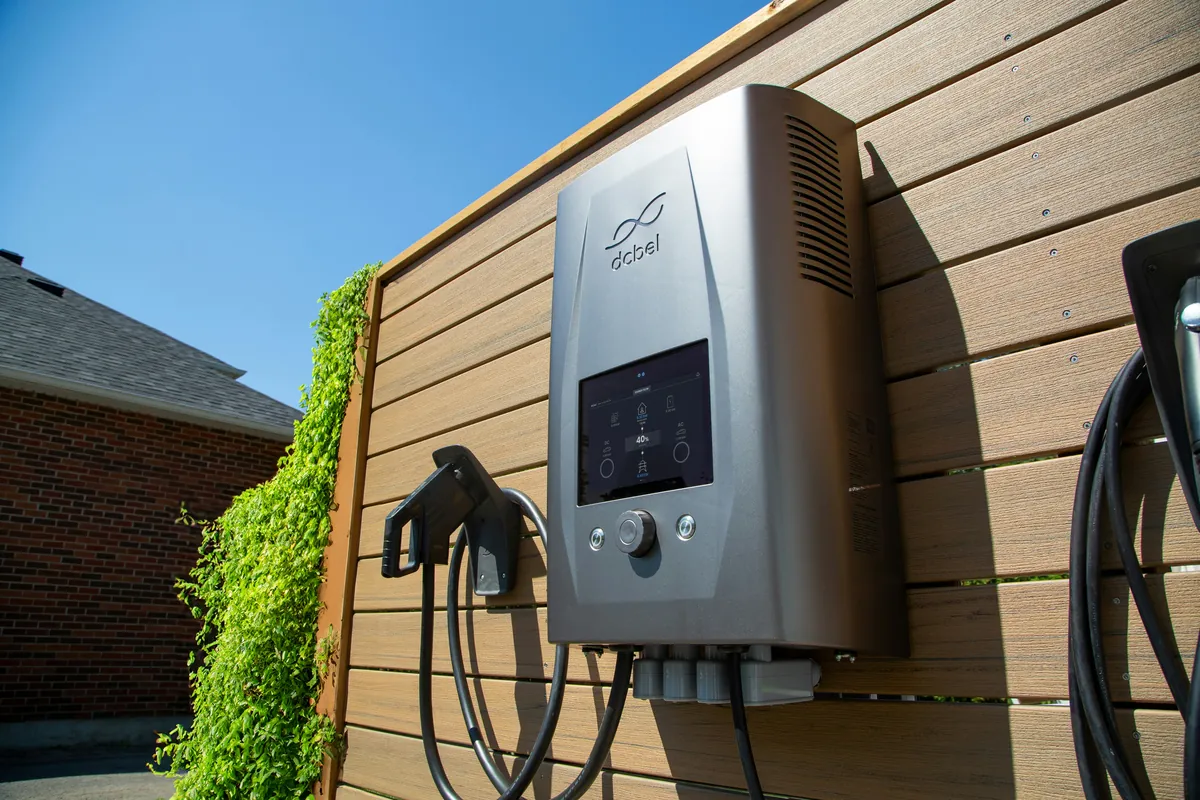


A Level 2 charger is a 240V circuit and a box on a wall. The install is not complicated, and in a house with capacity and a good location it is a half-day of work at a predictable price.
What makes EV quotes vary by thousands is not the charger. It is the order the decisions were made in. The mistake is treating charging as an appliance purchase — pick the unit, buy it, then find someone to hang it — when it is an electrical project whose cost was decided by the panel before the box was ever opened.
The mistake, in one sentence
Buying a 48-amp charger for a house that has no room for a 60-amp circuit.
That is it. The charger is the cheap part. The 60-amp circuit it demands is what triggers the service upgrade — a permit, a utility disconnect, a new meter base and panel, a day without power, and a bill several times the price of the hardware. And in a large share of the houses where it happens, nobody needed the 48-amp charger in the first place.
Why the bigger charger is usually the wrong buy
Charging speed is worth exactly as much as the driving you do overnight. The arithmetic:
- A 32-amp charger adds roughly 25 miles of range per hour.
- A 40-amp charger adds roughly 31.
- A 48-amp charger adds roughly 37.
Parked from 6pm to 7am — thirteen hours — the smallest of those puts on more than 300 miles. The average American drives about 37 miles a day. Unless you are routinely arriving home near empty and leaving again in four hours, the 48-amp unit is buying a speed you sleep through.
Now the other side of that ledger. EV charging is a continuous load, which the code counts at 125% of its rating:
- A 32-amp charger needs a 40-amp circuit.
- A 40-amp charger needs a 50-amp circuit.
- A 48-amp charger needs a 60-amp circuit.
On a 100-amp service in a house that also has electric water heating or a heat pump, 40 amps often fits and 60 often does not. Same car, same overnight charge, completely different project.
Before you buy anything: ask an electrician what your panel can take, and then choose the charger. It is a twenty-minute conversation that regularly saves five figures.
Three ways a house avoids the upgrade
When the load calculation comes out just over, a service upgrade is the first answer, not the only one.
- Load management. These devices — energy management systems, load sharing, DCC units — watch the whole-house draw and throttle or pause the charger when the range, the dryer and the heat pump all want power at once. The code explicitly permits the load to be calculated at the managed maximum rather than the charger’s rating, which is what lets a house that fails on paper pass in practice. The car simply charges slightly slower on the evenings it matters, which is to say you never notice.
- A meter collar adapter. A device that sits between the meter and its base and taps power ahead of the main breaker. Because it is a separate service tap, it does not load the panel at all. Availability depends on the utility and on your meter, so it is a check rather than a plan — but a free one to make.
- A sub-panel you already have. If the garage has a sub-panel, or an old 60-amp feeder to a shop, the circuit may be far cheaper from there than from the main panel on the other side of the house.
None of these is exotic. All three get skipped when a quote is written off a photograph of the panel instead of a site visit.
The second expensive mistake: no permit
The other way a cheap install becomes an expensive one is later.
An EV circuit is a permitted, inspected job in every jurisdiction in this metro. An unpermitted one costs less on the day and costs more three ways afterwards:
- At resale. Unpermitted electrical work is a standard inspection finding and a standard renegotiation. Retroactive permitting means opening finished walls so an inspector can see what is behind them.
- At claim time. An insurer investigating a fire has every reason to look at the newest, largest circuit in the house and ask who installed it.
- At rebate time. Utility and federal incentive programs generally require a licensed contractor and a permit number. No permit, no money — and the rebate is often a meaningful fraction of the job.
A permit is a small line on a quote. Its absence is not a saving.
Where the rest of the money actually goes
When capacity is not the constraint, cost is distance and finish:
- Run length. A charger on the garage wall directly behind the panel is an hour of work. The same charger on the far side of a finished basement, up a stud bay and past a fire-rated ceiling, is most of a day.
- Fishing walls versus surface conduit. Concealed is tidier and slower. In an unfinished garage, EMT on the surface is honest, cheap and completely normal.
- Voltage drop on a long run. Past roughly 100 feet the conductors go up a size, and wire is priced by the foot.
- Outdoors. A weather-rated disconnect, in-use covers, and a unit rated for the location.
- A detached garage. That is a feeder, its own grounding electrode system, and a trench — a different project with a different number.
Ask for the run length and the conduit route in writing. It is the line item that explains the difference between two quotes more often than anything else.
Hardwired or plug-in
A NEMA 14-50 receptacle looks like the flexible option, and it is — the charger comes with you when you move.
Two things to weigh against it. GFCI protection is required on that receptacle, and some charger-and-breaker combinations nuisance-trip on it, which means finding your car at 40% some mornings. And a plug-in unit is limited to 40 amps on a 50-amp circuit, so the full 48 is hardwire-only anyway.
If the unit is staying on that wall, hardwire it. If you genuinely expect to take it with you, plug it in and buy the receptacle from a brand the installer trusts — a cheap 14-50 carrying 40 amps continuously for years is its own future call to an electrician.
The charger that came with the car
Most EVs ship with a mobile connector — a portable cord that plugs into a standard 120V receptacle, and into a 240V one with the right adapter.
On 120V it adds three to five miles of range per hour. For a plug-in hybrid, or a second car that does short trips, that is genuinely enough and costs nothing. For a full battery EV driven daily it is not, and the common workaround — running it off an existing dryer or welder receptacle — is where people get into trouble. Those circuits were not designed for a continuous load, the receptacle was not designed to be cycled daily, and extension cords are specifically not permitted for EV charging.
If the mobile connector is doing the job on a 120V outlet, keep doing that and save the money. If you are reaching for adapters, that is the signal to install a real circuit.
What the numbers usually look like
Every house is different, but the shape of the pricing is consistent, and it is worth knowing which band you are in before the first quote arrives:
- Short run, capacity available, unfinished garage. The cheap, common case: a breaker, a short run of conduit, a hardwired unit, a permit.
- Long or concealed run. The same job plus half a day of labour, larger conductors and drywall repair.
- Sub-panel needed because the main panel is full but the service is not. A moderate addition, and it leaves you room for the next circuit too.
- Full service upgrade. The band everything on this page exists to help you avoid — and the one that is genuinely necessary in a minority of houses.
The difference between the first band and the last is decided in a twenty-minute site visit, before anyone buys hardware.
Choosing the wall
Worth ten minutes before anyone quotes:
- Where does the car actually park, and where is its charge port — front left, rear right? Cable lengths are typically 18 to 25 feet, and they route around the car, not through it.
- Will a second EV park here one day? Two chargers sharing one circuit with load management is far cheaper installed together than retrofitted.
- Does the door swing, or a workbench, sit where the cable will hang?
- Is the wall inside the garage or outside it? Outside is legitimate and common; it just changes the hardware.
- Is the panel on the way? If the natural charger wall is the far side of the house, ask what the same job costs on the near side. Sometimes the answer changes where you park.
What a complete quote says
A quote worth comparing names all of these:
- The load calculation result — a number in amps, not an opinion.
- The charger model, its amperage and the breaker size.
- Hardwired or receptacle, and which receptacle.
- Run length, conductor size and conduit type.
- Permit and inspection, included.
- Load management, if it is being used to avoid an upgrade.
- What happens if the panel turns out to need work once the cover is off.
If a quote opens with a service upgrade and none of the above is in it, get a second one. If it opens with a load calculation, you are talking to someone who has done this before.
The short version
Size the charger to your overnight drive, not to the spec sheet. Get the load calculation before you buy anything. Ask about load management and meter collars before you accept a new service. Pull the permit.
Most houses in this metro can charge overnight on the panel they already own — we will tell you which kind yours is before you spend anything.