
A backup generator is not one purchase. It is a generator, a transfer switch, a fuel supply, a pad, a permit and a maintenance schedule, and the price on the box covers only the first of those. The rest is where a reasonable budget turns into a painful one.
None of the mistakes below is exotic. Most are found after the hardware is bought.
Mistake 1: Sizing the generator by square footage
Square footage is the number every online sizing chart asks for, and it is close to useless. A 2,000-square-foot house with a gas furnace, a gas water heater and a gas range needs a fraction of the power of the same house with a heat pump, an electric water heater and an induction cooktop.
What actually sizes a generator is the load — what you want running, and what it draws at the worst moment:
- Running watts are what an appliance uses once it is going.
- Starting watts are what it pulls for the first second or two. Anything with a motor or a compressor — a well pump, a heat pump, an air conditioner, a sump pump — can draw several times its running current as it starts.
A generator that handles the running load comfortably can still stall, or trip its own breaker, when the well pump and the furnace blower start at the same time. You find out on the coldest night of the year.
Oversizing is the opposite mistake, and it is not free either. A bigger unit costs more, burns more fuel at every load, and may need a larger gas line or a larger tank than a correctly sized one.
The fix is a load calculation, done on site, against your actual equipment. It is the same arithmetic used to size a service upgrade, and it answers the real question: whole home, part of it, or only the circuits you cannot lose.
Before you buy anything: list what has to stay on in a three-day outage — heat, refrigeration, the well pump, a medical device, a home office. That list sizes the generator. The square footage does not.
Mistake 2: Skipping the transfer switch
A generator does nothing useful until it is connected to the house, and the connection is where people get hurt.
The dangerous version is the “suicide cord”: a cable with a plug on each end, run from a portable generator into a dryer receptacle or a spare outlet. It back-feeds the house wiring, and unless the main breaker is off, it back-feeds the utility line too. The transformer on the pole steps that power back up to distribution voltage, onto a line a utility crew believes is dead.
Every legitimate connection includes a way to make the house take power from the generator or the utility, never both:
- An automatic transfer switch senses the outage, starts a standby generator, and moves the house over in seconds. Nobody has to be home.
- A manual transfer switch does the same with a switch you throw yourself. It suits a portable generator, and it is far cheaper.
- An interlock kit is a mechanical plate on the panel that physically prevents the main breaker and the generator breaker from being on together. Where it is allowed, it is the least expensive safe option for a portable unit, paired with an inlet box on the outside wall.
The transfer switch is also where the “whole home or partial” decision gets made in hardware. A service-rated switch carries the whole house, usually with load management that sheds the big appliances when the generator is near its limit. A smaller switch carries a dedicated sub-panel of chosen circuits. Both are good designs. They are different prices, and the choice should come before the generator, not after.
Mistake 3: Treating the fuel as an afterthought
A standby generator runs on natural gas or propane, and its fuel supply is a project of its own.
On natural gas, the question is whether the meter and the piping can supply it. A whole-home unit at full load can burn as much gas as everything else in the house combined. The furnace and the water heater do not stop needing gas because the generator started — they are usually why it started. If the meter is too small, the utility has to upsize it, and that has its own lead time. If the pipe run is long or undersized, the generator starves under load, which looks exactly like a generator that is too small.
Natural gas also produces somewhat less power than propane from the same engine. Check which fuel a unit’s rating assumes before comparing kilowatts.
On propane, the question is how long the tank lasts. A whole-home unit at half load can go through a couple of gallons an hour. A 500-gallon tank is only filled to about 80%, so it holds roughly 400 usable gallons. Work out how many days of outage that covers before you size the tank — and note that delivery trucks tend to be busiest in exactly the weather that causes outages.
Either way, the gas run is part of the install price. A quote that covers the generator and the electrical but leaves the fuel to “your gas contractor” is not a complete quote. Ask for the run length and who is doing it.
Mistake 4: Picking the location last
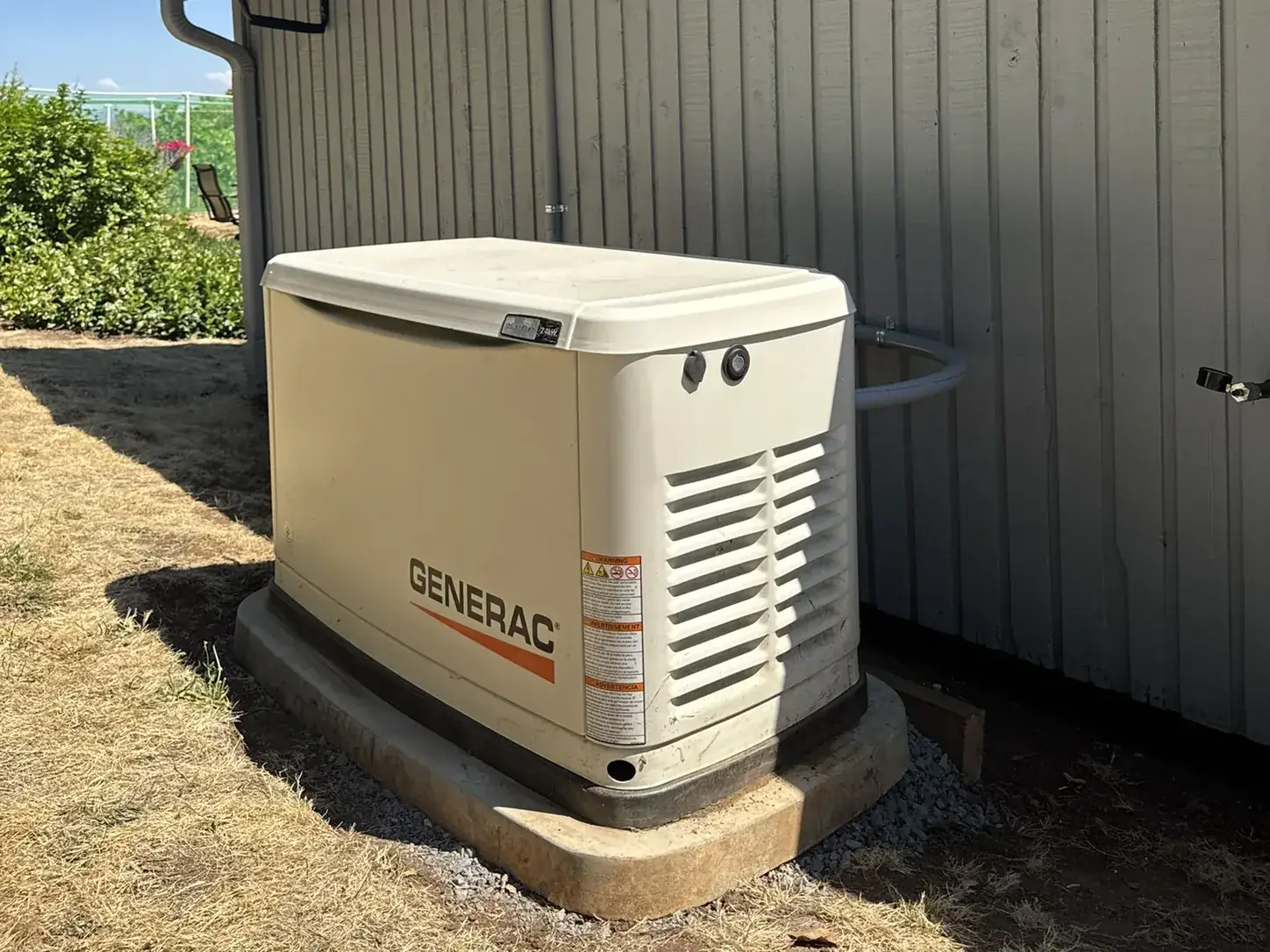
Where the generator sits decides how much of the install is pipe and wire, how loud it is from the bedroom, and whether it passes inspection.
Placement is not a matter of taste. It is governed by the manufacturer’s installation instructions and by code, and the rules exist mostly because of carbon monoxide:
- Clearance from openings. Exhaust must stay well away from windows, doors, soffit vents and fresh-air intakes. Manufacturers generally specify around five feet from any opening, and a set distance from the wall itself.
- Clearance for service. Someone has to be able to open the enclosure and change the oil.
- Setbacks and noise. Many jurisdictions and HOAs have rules on how close a generator can be to the property line, and how loud it can be at it.
- Ground. It needs a level pad above standing water, and out of the path of snow sliding off the roof.
Portable generators have their own version of this rule, and it matters more: a portable unit running in a garage, even with the door open, is how carbon monoxide deaths happen after every major storm. Guidance is typically to keep it about 20 feet from the house, with the exhaust pointed away from it.
The expensive version of this mistake is a unit placed for looks on the far side of the house from both the gas meter and the electrical panel. Every foot of separation is pipe, wire and trenching. The cheapest location is usually close to both — so walk the site with the installer before the order goes in.
Mistake 5: Treating it as an appliance, not a system
The last mistake is assuming the job is finished when the generator first starts.
The permit. A generator install is a change to the electrical service — a new transfer switch, new circuits, usually new gas work. In Oregon that is permitted and inspected work. An unpermitted install saves a little on the day and costs more later: at resale, when an inspector finds it; at claim time, when an insurer asks who installed the newest equipment in the house; and when the manufacturer asks for proof of installation under the warranty.
The installer. A unit bought online and installed by whoever is available can be fine. It can also void the warranty, if the manufacturer requires an authorized installer or registration at startup. Read the warranty terms before you choose who sets it, not after something fails.
The maintenance. A standby generator runs a short self-test every week or so and otherwise sits outdoors for years. Oil, filters, spark plugs and above all the starting battery are what fail, and they fail quietly. The test that matters is the outage, and a generator that has not been serviced in four years is not a backup plan.
Is a generator the right answer at all?
Sometimes the honest answer is a smaller project.
- If outages are short and infrequent, a battery system covers hours rather than days, runs silently, and needs no fuel. It pairs well with solar.
- If you already own a portable generator, an inlet box and a manual transfer switch or interlock turns it into a safe, legal backup for a small fraction of the cost of a standby unit.
- If you only need heat and refrigeration, a critical-circuits setup is a much smaller generator, a much smaller gas demand, and a much smaller bill.
A standby generator earns its price when outages run for days, when someone depends on power for health, or when a well pump means no water without it. That is a lot of houses. It is not all of them.
What a complete quote says
A quote worth comparing names all of these:
- The load calculation result and what it assumes is running.
- The generator model and its rating on your fuel — natural gas and propane ratings differ.
- The transfer switch type and size, and whether it carries the whole house or a sub-panel.
- Load management, if the whole house is on a unit smaller than its peak demand.
- The fuel supply: gas meter capacity or tank size, pipe size and run length, and who does it.
- The location and pad, with clearances checked.
- Permit and inspection, included.
- Startup, a test under load, and the first year’s maintenance — or what maintenance costs after.
If a quote is a model number and a price, it is a catalog page. Ask for the rest before you sign.
The short version
Size the generator to what has to stay on, from a load calculation, not from square footage. Never connect it without a transfer switch. Settle the fuel supply and the location before you choose the unit. Pull the permit, and plan on servicing it every year.
Get those right and a generator is the most boring appliance you own — it starts, it runs, and you hardly notice the outage. We size, install and service backup power across the metro, and we will tell you which setup your house actually needs before you buy anything.