
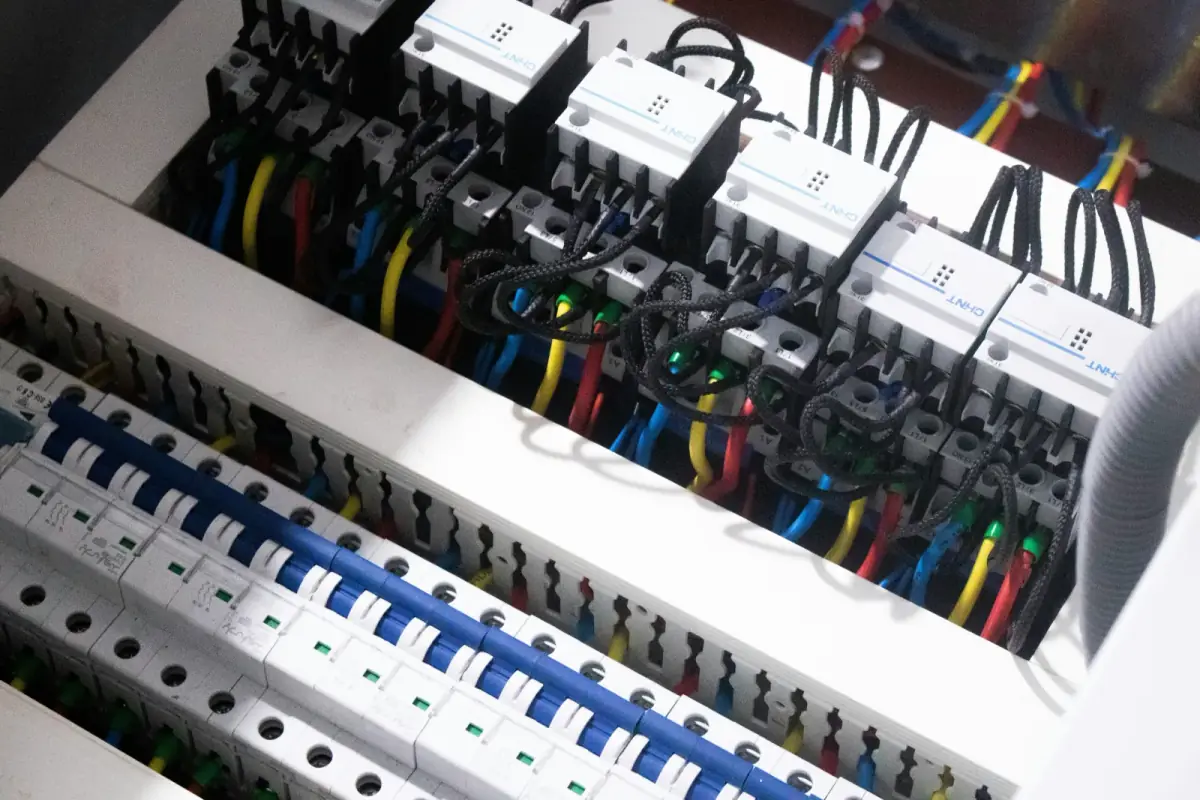
An electrical panel is the one piece of equipment in a house that every circuit passes through, and the one almost nobody looks at until something stops working. Most are built to last 25 to 40 years. Plenty in the Portland metro are well past that, and a good number were obsolete the day they were installed.
Here are the seven signs worth acting on, roughly in order of how long they can wait.
1. The brand is one of the recalled ones
Some panels are a replacement conversation regardless of age, capacity or condition:
- Federal Pacific Electric (FPE) Stab-Lok. Independent testing found a significant share of these breakers fail to trip on overload. A breaker that does not trip is the one failure mode the whole system exists to prevent.
- Zinsco / Sylvania-Zinsco. The bus bars corrode and the breakers can weld themselves to them, with the same result.
- Challenger. Later panels with documented overheating at the breaker connections.
These are not “monitor it” situations. If the label inside your panel door says one of those names, the panel is the problem, and nothing else on this list needs to be true.
There is no repair path here either. Replacement breakers for these panels are either unavailable or are the same design that caused the problem, so replacing the panel is the fix rather than one option among several.
Worth knowing: most home inspectors flag these on sight, and many insurers now ask about them directly. Replacing one is often the cheapest way to close both conversations at once.
2. Anything is warm, discoloured or smells
Put the back of your hand near the panel cover. It should be at room temperature. A panel that is warm to the touch, a breaker hotter than its neighbours, browned or melted plastic around a breaker, or a smell of hot plastic or fish anywhere near it — any one of those is a same-week call, and a burning smell is a same-day one.
Heat at a connection means resistance, and resistance at the current a panel carries is how fires start. The usual causes are a loose lug that was never re-torqued, a breaker that has been carrying near its rating for years, or corrosion on the bus. None of them improve on their own, and all of them get worse under load — which is to say, on the coldest week of the year.
This is the one item on the list that does not wait for a convenient appointment. It is a diagnostic call, today.
3. Breakers that trip repeatedly, or will not reset
A breaker tripping is a breaker working. A breaker tripping every week is a message, and a breaker that will not stay set has usually stopped being a breaker.
Worth separating two cases. If one circuit trips and the cause is obvious — a space heater and a microwave on the same kitchen counter — that is a circuit problem, not a panel problem, and the fix is a dedicated circuit. There are really only four things a tripping breaker can mean: an overload, a short circuit, a ground fault, or a breaker that has worn out. Three of those have nothing to do with the panel at all, which is why a diagnostic visit starts by measuring the circuit rather than by opening the panel.
If breakers across the panel are tripping below their rating, though, or a brand-new breaker behaves exactly the same way in the same slot, the bus itself is the suspect. That is a panel diagnosis, and it is the point at which replacing individual breakers stops being useful.
4. There is no room left
Open the cover and count. If every slot is full, if there are tandem breakers stacked to make room, or if there are two conductors under a lug listed for one — a double tap — the panel has already been asked for more than it was built to hold.
This matters the moment you plan anything. A heat pump, an induction range, a hot tub, a finished basement, a shop in the garage, an EV charger: all of them need a slot, and a panel with none is the first line item on every quote you will get.
It is worth knowing the difference between “full” and “at capacity”, because they are different problems with different prices. A full panel with plenty of service left can sometimes take a sub-panel, which is a fraction of the cost. A panel that is out of amps is a service upgrade. Which one you have is settled by a load calculation — the Article 220 arithmetic that takes the square footage, the fixed appliances, the largest motor and the heating and cooling, applies the code’s demand factors, and returns a number in amps. If that number lands under your service size, the fix is space. If it lands over it, the fix is a service upgrade.
5. Fuses instead of breakers
A fuse box is not inherently unsafe — a correctly sized fuse protects a circuit perfectly well. The problems are practical.
Fuses get replaced with larger ones when they blow, which defeats the protection entirely; a 30-amp fuse in a 15-amp circuit’s holder is common enough that electricians look for it first. There is rarely any equipment ground. And the panels are typically 60 amps, which was a complete service in 1955 and is roughly what one modern kitchen wants today.
A fuse box also rarely travels alone. A house that still has one usually has original branch wiring to go with it, and rewiring is its own project — the two jobs are far cheaper done together than done five years apart, because the panel is opened once instead of twice.
Insurers treat fuse boxes much the way they treat knob and tube. If you have one, you have probably already had that conversation.
6. Lights that dim or flicker when something starts
Lights dipping briefly when the air-conditioning compressor starts is normal — a motor’s inrush current is several times its running current, and the whole house sees it for a fraction of a second.
Two patterns are not normal:
- Lights across the house flickering, or brightening in one room while dimming in another. That is a classic sign of a failing neutral at the service — a fault that lets voltage swing above and below 120V, and that takes appliances and electronics with it. Call about that today.
- Persistent flicker on one circuit that follows the circuit rather than the fixture. Usually a loose connection somewhere on it, sometimes at the panel itself.
Neither one is a lighting problem, and neither is fixed by changing a bulb. If the flicker turns out to be dimmers fighting their fixtures rather than a fault, that is a different conversation — lighting and controls, not the panel.
7. It is simply old — and has never been touched
Age alone is not a defect. But a panel installed in 1978 has spent nearly fifty years thermally cycling, and its breakers are mechanical devices with springs in them.
Combine that with what usually accompanies an untouched panel of that age and the replacement stops being about the box:
- No AFCI protection on the bedroom and living-area circuits.
- No GFCI in the garage, the crawlspace, or on the exterior receptacles.
- A grounding electrode system that predates current requirements — often a single rod, sometimes a cold-water bond to a pipe that has since been replaced with plastic.
- Aluminium branch circuits, in some houses built between roughly 1965 and 1973.
If yours is over 30 years old and has never been inspected by an electrician, that inspection is worth an hour of somebody’s time. It is also the cheapest part of the whole exercise.
What you can check yourself, safely
Nothing here involves removing the panel’s inner cover — that is energised even with the main off, and it is not a homeowner job.
- Read the label inside the door. The brand is sign 1, and it is the single most valuable thing you can learn in thirty seconds.
- Read the main breaker. The number on it is your service size: 60, 100, 125, 150 or 200 amps.
- Look at the cover, not behind it. Rust, water staining, scorch marks, a cover that does not sit flat.
- Feel the outside of the door, and smell. Warmth or any burnt smell is sign 2.
- Count what has a breaker and what does not, and check whether the directory matches reality.
- Photograph all of it. A clear photo of the label and the breaker rows answers most of an electrician’s opening questions before anyone drives out.
What replacement actually involves
For most houses in this metro it is a one-day job:
- A load calculation and a permit. The calculation decides whether you are replacing 100 amps with 100, or moving to 200.
- A utility disconnect, scheduled in advance. Power is off for most of the working day.
- The new panel and, if the service is changing, a new meter base, service entrance conductors and — on an overhead service — the mast and weatherhead.
- Grounding and bonding brought to current code. The quiet half of the job, and the half that most often was never done properly in the first place.
- Circuits landed, AFCI and GFCI protection added where it is now required, and the directory labelled for real, not in pencil.
- Inspection, then the utility reconnect.
What moves the price
Two quotes for “a panel replacement” can differ by thousands, and it is usually one of these:
- Panel only, or panel and service. Reusing the existing meter base and service conductors is a materially smaller job than replacing them.
- Overhead or underground. An underground service means a trench and conduit; an overhead one means a mast.
- Where the panel is. A panel being relocated — out of a closet or a bathroom, where they are no longer permitted — is a new feeder and drywall work.
- What the old panel was hiding. Undersized neutrals, missing grounds, a sub-panel with the neutrals and grounds bonded together. These surface once the cover is off, and an honest quote says how they will be handled rather than pretending they will not appear.
If you recognise one of these
Signs 1, 2 and the whole-house flicker in 6 are calls to make now. The rest are worth a look before your next project, because they decide whether that project starts with a panel or not.
Either way it starts the same way: someone takes the cover off, looks at what is actually in there, and runs the numbers. That is what a panel and service upgrade quote from us begins with, and it is free — see the rest of our residential electrical work for what tends to follow it.